
On "Autocrat's Can't"
Reflecting on the book two years out... ahead of the new book

Precis/TL;DR: in which we take an extended look at Brown, Schaaf, Anabtawi, & Waller (2024), from successes to disappointments to ‘lessons learned.’ An exercise in organizing my own thoughts before beginning the drafting process for Waller (202x).
We Wrote a Book Two Years Ago
It’s been nearly two years since our book, Autocrats Can’t Always Get What They Want, was published by University of Michigan Press. For some newsletter subscribers, this book may be ‘new news.’ If so, I invite you to pick it up. For others, you have heard about the thing regularly. For a select few, you might have even read it (!)
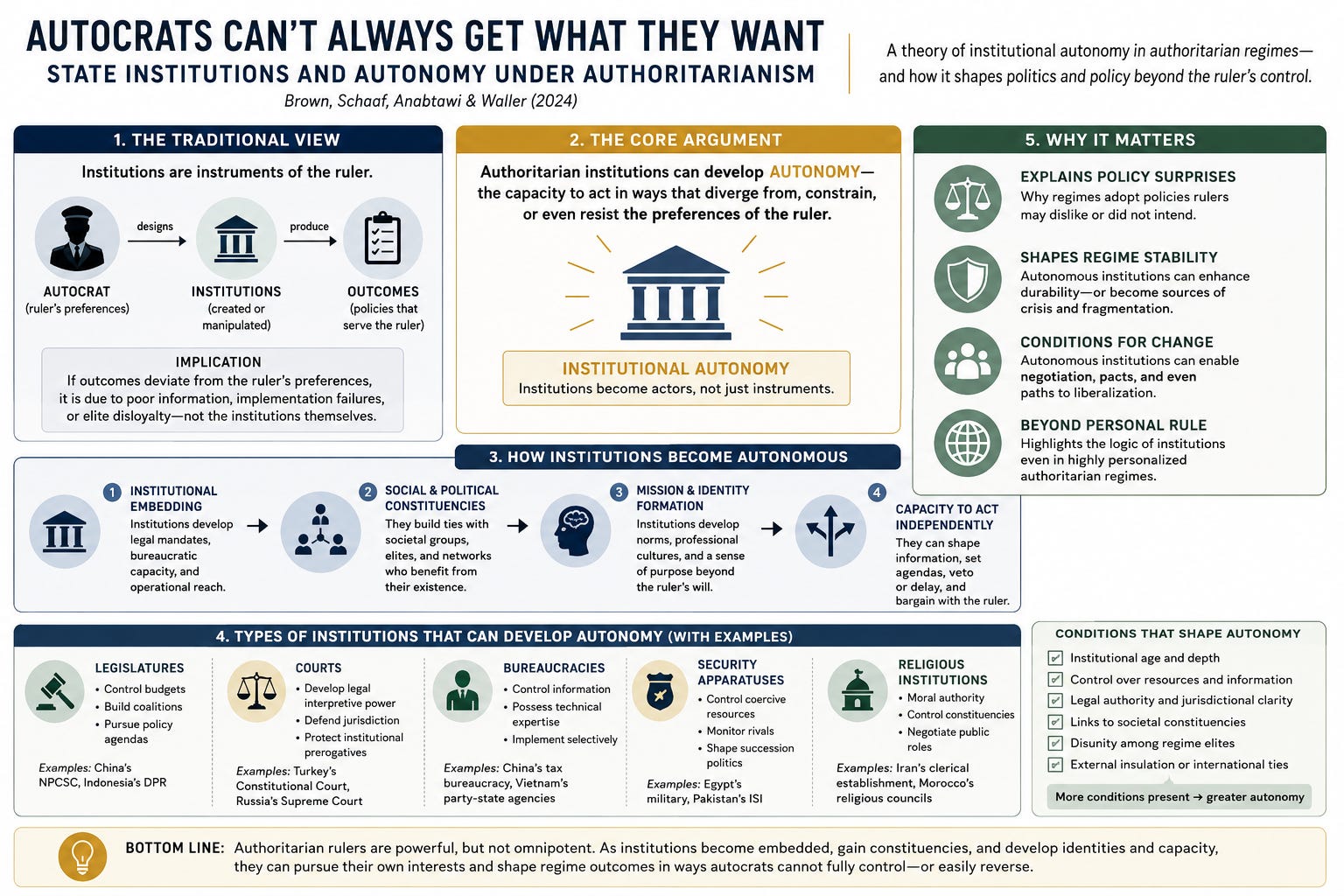
I wanted to write a reflection on the book both as a finished academic product and in regards to the process of writing it. This is something of a self-indulgent exercise, but also a process of generating select ‘lessons learned.’ So bear with me. If you’re entirely unfamiliar and want a quick summary to start off, look here.
By all rights, nearly two years in the book is both a success and a disappointment. Although I will caveat what I mean about the latter in a second, as it is a little early still on that count. What follows are my own personal views alone and not those of my wonderful coauthors, to be absolutely clear.
The Subfield Context
By the most important metric of genuine, original contributions to an academic discipline and to what we sometimes call knowledge creation or knowledge generation, Autocrats Can’t is the real deal.
Our intention (or, I should say, my personal interpretation of our intention) was to write something that would fit within the contemporary academic canon of books in the comparative authoritarianism subfield. That is, the political science research agenda on authoritarian systems of government, what they look like, and how they work.
This canon is relatively small. Small enough that I can list its modern ‘greatest hits,’ which would form the bulk of any proper grad-school reading list on authoritarianism today.
That list would consist of something like Voting for Autocracy (Magaloni, 2006), Authoritarianism in an Age of Democratization (Brownlee, 2007), Political Institutions Under Dictatorship (Gandhi, 2008), Competitive Authoritarianism (Levitsky & Way, 2010), Ordering Power (Slater, 2010), The Politics of Authoritarian Rule (Svolik, 2012), Constitutions in Authoritarian Regimes (Ginsburg & Simpser, 2013), How Dictatorships Work (Geddes Frantz, & Wright, 2018), and a few more.
Newer entries would probably include Constraining Dictatorship (Meng, 2020), Popular Dictatorships (Matovski, 2021), Spin Dictators (Guriev & Triesman, 2022), and Revolution & Dictatorships (Levitsky & Way, 2022). Earlier writing in this vein of scholarship would include Totalitarian Dictatorship & Autocracy (Brzezinski & Carl, 1956), Political Order in Changing Societies (Huntington, 1968), Transitions from Authoritarian Rule (O’Donnell & Schmitter, 1986), and Totalitarian & Authoritarian Regimes (Linz, 2000).
These are all explicitly comparative works (excepting Magaloni, but she was in some ways the first-mover for the 2000s generation), they all make big, theoretical claims about how authoritarian politics works, and nearly all put a special focus on institutions.
Elections, as well as parties, legislatures, courts, and other organizational bodies feature heavily, alongside strong emphases on elite coalitions, regime-type, and survival/durability (although there are other ways to divide these up too). This is an influential paradigm to understand authoritarianism, and supplements more regionally-specific monographs as well.
For example, in my post-Soviet regional world you could also easily add Patronal Politics (Hale, 2014) and The Origins of Dominant Parties (Reuter, 2017). A China/Vietnam scholar would probably add Making Autocracy Work (Truex, 2016) or United Front (Schuler, 2021). Africanists might throw in Legislative Development in Africa (Opalo 2019). And so on. Cornell’s Tom Pepinsky calls this wave of scholarship the “institutional turn” in the subfield.
Our book is meant to fit into debates provoked and explored by this genre of research starting in the 2000s and continuing today. Beyond this core canon of monographs, the field also exists in the form of influential academic articles published in premier political science journals (there are many - you can ask me for the critical ten or so), and aligns with a parallel research effort in political economy such as The Political Economy of Dictatorship (Wintrobe, 1998), The Logic of Political Survival (Bueno de Mesquita et al. 2002), or Economic Origins of Dictatorship & Democracy (Acemoglu & Robinson, 2005).
I futzed around with chatGPT and produced this (definitely not reliable) illustration of citation centrality for a version of the whole cluster below.
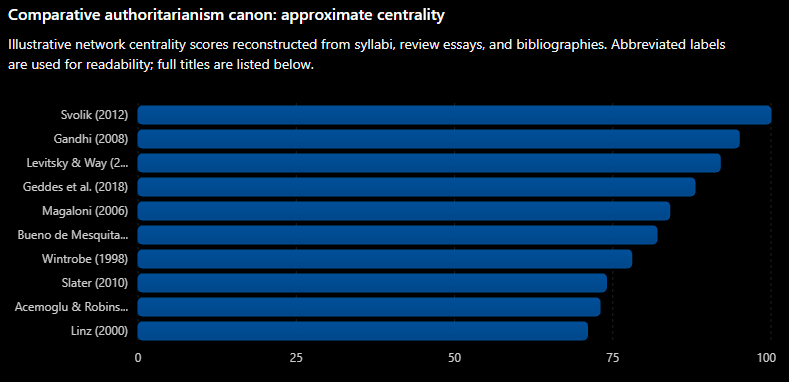
These sorts of books are big signposts for major arguments and assertions about the nature of non-democratic systems of government (or as readers of this newsletter know to say: authoritarian regimes). They are meant to be go-to citations for literature reviews that capture particular emphases or schools of thought, and are filled with both theoretical claims and empirical work, either quantitative or qualitative (or both).
In the sense of pure contribution and productive engagement with this major research area, I am not too modest to say that we succeeded.
Genuine Successes
What exactly do I mean? Let me lay out a few contributions that one could take from Autocrats Can’t that had not yet been formulated by the work of other colleagues. That is to say, any of these points would be enough to justify a gratuitous citation in your own research, should you require it.
The problem of ‘functionalism’ in over-explaining authoritarian politics
In brief: the current research field relies heavily on functionalist logic when make theoretical claims about authoritarian politics. X or y institution has some inevitable function or purpose that helps the regime (or more often, a stylized ‘autocrat’) prolong its life or improve some outcome. Thus, legislatures are supposed to coopt elites through rent distribution, elections act as information gathering operations, and courts resolve elite conflicts.
We argue that this is sometimes true and sometimes false - whether or not an institution ‘does’ something for a regime is a research question, but cannot be an assumption. And we provide close empirical detail supporting this rejection of automatic functionalism.
Nailing down ‘regime’ and what we even mean by authoritarianism
In brief: scholars like to define regime as a congeries of norms and institutions, but then rarely use it this way in practice, but rather overwhelmingly deploy it as a shorthand for a ruler and his elite circle, with considerable vagueness on how to separate ruler, regime, and state. We clarify this in actual practice and note key differences.
Similarly, scholars have fallen into using ‘authoritarianism’ as a term to describe all non-democratic systems of government, without fully grasping what this implies by lumping such a large group of cases together. We make this explicit and begin the process of teasing out implications, such as the problem of assuming tyranny, the necessity but insufficiency of regime-type, and the importance of moving analysis from the top-down to the inside-up (and out).
The diversity of institutions in authoritarianism
In brief: some scholars think of institutions in authoritarian regimes as fundamentally interchangeable tools (a common corollary of functionalism), others recognize distinctions but assume all institutions of one type operate in a similar way (ditto).
We show the former to be obviously wrong and the latter untenable. We argue political context, path dependence, and contingency weigh heavily on institutional ‘role,’ evolution, and change, which varies strongly from country to country, time period to time period, and institution to institution - even when formal organizational formats may otherwise look similar.
Conceptualizing autonomy, institutionalization, and horizontal/vertical linkage
In brief: we introduce a theoretical argument for when we should expect institutions in authoritarian regimes to guard their prerogatives, to be active, or even to ‘act up’ and frustrate rulers.
In doing so, we introduce a two-part concept of institutional autonomy as well as explanatory variables of institutionalization and linkage that allows us to explore and explain variation over time and across countries. This is new, and the primary theoretical contribution.
Recovering agency, contingency, and evolution
In brief: by rejecting functionalism and highlighting the diversity and pluralism across both regimes and the institutions within them, we end up playing with the tools of ‘historical institutionalism.’
We end up emphasizing the role of elite agency, unpredictable contingency, unintended consequences, and development over time without requiring a single, overarching operational logic - one which simply does not exist when examining the actual empirical world in detail. This is the defining feature of our detailed, granular case studies across three institutional formats: constitutional courts, parliaments, and religious establishments.
Bringing religion back into the study of authoritarian institutions
In brief: although the study of religion and its relation to society, social practice, and political order is longstanding in other disciplines (as well as in regional studies and single-case accounts), it is often absent in major comparative authoritarianism research, or otherwise handwaved as another functionalist tool in the dictatorial belt of control techniques.
We rectify this, and in doing so provide a much deeper (and more complicated) picture of authoritarian politics in a world where strict church-state separation, until very recently in most parts, simply does not exist.
Reintroducing historical experience before 1945/1991
In brief: many of the most influential studies of authoritarian regimes rely on quantitative datasets extending back only since the end of the Cold War or the end of WWII or qualitative case studies similarly located in time. When they do take historical cases, they tend to apply categories developed for the modern era.
We look further back in select empirical cases (Imperial and Nazi Germany, parliamentary evolution in general, the Buddhist Sangha establishment in Thailand) and discuss in detail in what ways such comparisons help or complicate our contemporary theories.
There are more contributions in the book (and I haven’t even touched on our conclusions about what our study suggests about modern democracy), but these stand out as particularly relevant and obvious. That’s quite a lot!
In many ways, Autocrats Can’t was born out of frustration with existing paradigms given what the four of us knew about the real countries we have individually studied. This was our effort at an answer (or series of answers), and it produced genuine contributions to a field still dominated by assumptions we often find unworkable or insufficient.
Current Disappointments
That’s all to the good. But you’ll note, I did say that Autocrats Can’t was both a success and a failure. Or at least, it has been so far. I think there are three major disappointments now that we are closing in on the book’s two-year anniversary. These will feed directly into some ‘lessons learned’ for me personally (see below), but they are worth noting now:
The book has been very sparsely reviewed
Now, academic reviews take a long time. The average time between publications and reviews for academic books is exactly the inverse of popular press books. A popular press book will have review copies sent out to reviewers months ahead of time, with the goal of getting reviews in front of peoples’ eyeballs within days or weeks of the book’s launch. This is not the case for academic books, where the average review appears only one, two, or even four years after publication.
Still, since our publication date of August 2024 I can count only two (2x) academic reviews of Autocrats Can’t to my knowledge. First, a very brief review on the Middle East scholar Mark Lynch’s blog (which barely counts). And second, a kind but careful review note by the Norwegian academic Carl Henrik Knutsen (a genuine name in the field) in the Journal of Peace Research. Knutsen is very far from our own scholarly views on a number of issues, so I take this as a victory. But it is a minor one.
There are hopefully more reviews forthcoming (our publisher told us it was sent out widely to the relevant academic journals…), but it is a slow start. And without reviews, it is harder to get more eyeballs on the book in the first place.
The book has been very sparsely cited
Academic citations always lag publication, not least because the citing author needs to 1) read the book first and 2) decide it is relevant to an ongoing or new research project. So two years with few citations is not horrible. But it is still disappointing.
By Google’s count, Autocrats Can’t has only been cited by 12 other publications as of May 2026. Two of them are from me or my coauthor Steven (and I will keep citing the thing, don’t worry). Only two more are from names I immediately recognize (Henry Hale and Alexander Libman, respectively). One is in a cool paper by Cianetti et al on regime-type, which should help. But that is quite meager - very far from ‘major entry into the canon’ level.

All readers should add to this citation count forthwith! As well as reviewing it on Amazon, of course… The book’s framework has not been taken up by other scholars for their own purposes
Correlated to not being reviewed much or well-cited (thus far), none of our arguments have (yet) seeped into the broader literature. A good ‘canon’ book will have many authors using it as the building-block for their own research to develop from (ideal) or at least employ it as a punching bag against which their research opposes or otherwise proves wanting (that’s ok too). Autocrats Can’t has neither of these things, which means our impact two years on has been quite low.
Lessons Learned
This brings me to some lessons learned from the whole process. Some are directly related to the above. Others are more personal reflections that I hope to use down the road as I start my next book project this month. I’ll go from bigger lessons to more bespoke ones in order.
Big Lessons
These are mostly process or book publishing lessons that I hope to take into the next book…
Take care with your publisher, and follow up every step of the way
Academic publishing takes a long time even in good circumstances, but our book took far longer than ideal. We had a first draft to a publisher in 2018 (Oxford, boo hiss), who then ‘ghosted’ us after sitting on it for something close to two years. University of Michigan Press was far better to us, but it still took from 2021 to 2024 to go from submitted manuscript to publication.
Publish a book when you actually have time to promote it yourself
We learned the hard way that academic publishers often don’t market books very well (thus the sparse reviews). So you really need to develop a paper trail that highlights or otherwise directs readers to the book. We wrote one summarizing essay (a glorified blog post), Nathan and I did two book panels at GWU in 2024 to promote the book (one of which you can find here), and Steven presented a version of the argument at one conference.
But that was it. In hindsight, this was hardly sufficient. We never did a book tour or anything of the sort. We didn’t go on podcasts. And we did not keep up a cadence of other writing plugging the book elsewhere. We never developed a promotion strategy, and that has turned out to be a mistake.
Avoid collective action problems and author attention issues
A four-person coauthored book is an exercise in extensive coordination. Our experience of this was one that resulted in continual delays due to our own busyness. Three of us were still pursuing doctoral research and writing at the time, and we lost years to different people doing research fieldwork (including myself) that slowed down the process. The long drafting probably helped us sharpen ideas (we were playing with evolutionary biology metaphors for a while that I’m glad we dropped), but it also meant we got tired of our own project.
Furthermore, after publication we were mostly in different stages of starting our own post-Ph.D careers and were understandably pulled in a variety of directions. Our attention was never fully on the book, even on publication day. As a result, investment in book-related efforts was curtailed simply due to a lack of time or energy, in addition to not really thinking about it strategically.
Write an article-length version of the book ASAP
Most influential books in the subfield have companion articles published in one or another academic journal that summarize the main argument. A 30-page journal article in PDF form is much more digestible than a nearly 300-page work.
Sometimes this happens organically, with the book project coming out of a series of research papers (or one big, show-stopping piece) written earlier. Others make a point of writing a summary paper after the fact. We did neither, and I think this has hindered us in staking and disseminating our claims in the field.
Small Lessons
This is where I will get into a little bit of self-criticism that isn’t about process or the broader publishing ecosystem, but things we could have done differently in the book itself…
Make the argument snappier and make fewer of them
As far as I’m concerned, our book is erudite, insightful, and jam-packed with important contributions. But one can always improve on these things, and I think the book could have done with making its major arguments clearer sometimes.
We have a wonderful title (which we came up with quite late - the original working title was the much less pithy “Authoritarianism from the Inside”!). But even something memorable like our Autocrats Can’t Always Get What They Want doesn’t fully tell you what’s in the book. I listed seven different distinct contributions above, and I deliberately left out several more that I care about but would have overwhelmed this newsletter entry. That’s a lot, hard to summarize, and even harder to digest until you actually dig into the full span of the book.
The most influential books in the comparative authoritarianism canon have one or two big statements, and then a plethora of sub-claims and insights. For example, Svolik (2012) has a nice line very early on that “all authoritarian regimes must resolve two fundamental conflicts... the problem of authoritarian control... and the problem of authoritarian power-sharing.” That’s really clean! It nails what the book is about, introduces the two key moving parts, and is readily quotable. There was a way to do this with ours, but our framing didn’t quite get there.
Beware of rambling intros and unnecessary repetition
The biggest criticism I’ve heard of the book from people who have actually read it is very straightforward: our introductory matter is too long and we repeat ourselves more than we should. We have two large chapters that set the stage, critique the existing literature, provide definitions, make the argument(s), introduce conceptualizations, and develop the theory. The first is about 50 (!) pages long, the second is another 30.
This probably needed to be three chapters, each a bit shorter and more concise. And the reader is still almost at page 100 when he or she get to the first case study (which, I will note, we say are also used to further develop and contextualize our theory inductively - and they really do, but that’s a lot!)
All of this is not an insuperable problem, but it is one nevertheless. One of my best students actually took the time to read our book over his winter break and that was his big critique - it’s a bit of a time-suck to get to the empirical meat, and we hammer in so much that there’s a potential to be overwhelmed. Especially if one is reading casually, rather than for purely academic purposes.
This also relates to that repetition issue, which is very much the result of a four-person coauthorship. Each of us wanted to make sure our particular points of interest were in there, and as we took turns with the draft manuscript we ended up regurgitating key arguments a few times too many. The empirical chapters often have little reintroductions of the main argument, which probably needed to be skimmed down. This is probably a fault that an editor might have spotted earlier on, but that didn’t happen (or not enough).
Include visuals, tables, and charts
Finally, the book could have used more visual cues to illustrate the argument, highlight the key conceptual claims, and show variation in tables or charts. I’ve become a huge convert to the necessity of visualizing an argument (my CNA colleagues can certainly tell you - with some eye-rolling - about my repeated efforts to introduce these in every report we write) but I mostly came to this personal conclusion long after we finished drafting the manuscript.
At some point we made an active decision not to introduce tables or schematic charts, which is fine. It’s an older-school way of writing a big academic text. But I think it’s become something of a weakness, not least because people’s attentions have shrunk in recent decades and would be served well by visual reminders. But also, it makes it harder for others to teach the book: you can’t copy-paste a table or visual for your PowerPoint slides if it doesn’t exist, and making one yourself adds work that busy professors might be disinclined to attempt.
There’s much more to say on all of the above, and these points are only some of a larger bevy of relevant takeaways or framings. As I always note, anything in this newsletter is something like a first (or perhaps second) draft, not a finished product.
Nevertheless, all of this is in service to my next extracurricular task: writing the next book on the evolution of authoritarianism. This month’s task is to get real pen to paper on the first chapter draft of that new project. You’ll hear more in due course. With any luck, we’ve learned something useful to that end.
As always, thoughts are welcome. And make sure to buy the book! :)
If You Got This Far
I have a poll for you to take…
That’s all from me for now!
- Julian
"The canon is relatively small," but not going to lie, just reading the list of books that comprise the canon made me feel a little tired.
Facetious comment: write something which attacks the positions of Yarvin That seems to attract his attention and your fame & reputation will flow of the back of him. In fact why stop there, go for Bannon and Tucker as well. You will be the talk of political right and a figure of reverence and loathing though out America land and beyond. So join the fight, explode the myths, ground us in reality. Let’s talk authoritarianism and why it might or might not suit you. In your own words!